


Photo by Sunny Li
In 2026, I’m working with 100 founders
I’m giving 100 founders access to my pattern library and a free strategic audit.
I’ll review your 2026 plans and tell you what breaks first. After our 60’ phone call, I’ll send you a written assessment and circle back with 30 and 90 day follow-up calls.
Get it here:
Intro
People set big goals like it’s the holy grail. They climb a ladder that’s leaning against the wrong wall.
You can get rich but wipe out on the beach of your acquirer.
You can have the perfect engineering team but your big dreams are put on ice for a few decades.
What worked for me is designing a life instead of setting goals for a startup.
Years ago I wrote out what my ideal day looked like.
The program is small enough to fit in my head. I don’t need an app and wearables to track progress. Just a paper notebook.
After all these years, I can say that I have achieved the optimal lifestyle I wanted back then. Bizarrely, many of the goals I’ve set, though, are still incomplete. But what drives the most meaning and fulfillment is knowing I’m living on my terms.
Goals are often nothing more than distractions designed as bragging rights, and shiny objects that, once you get them, make you feel nothing.
Real wealth comes from design, not from goals. There are 3 reasons for this:
You’ve probably noticed that winners and losers have the same goals.
Achieving a goal is momentary.
Goals are not long-term progress.
In this essay, I’ll talk about why the design of your TechBio company matters more than your goals for FDA clearance. Instead of driving your TechBio company to achieve goals - design for time, design for change and design for buyers.
Let’s learn from the story of Zebra Medical.
We’ll see a company wiped out 8 years after founding after they developed a robust deep learning platform for detection of bone, liver, lung, and cardiovascular diseases and 7 FDA 510(K) clearances.
The story of Zebra Medical Vision
In 2011, Eyal Gura injured himself while scuba diving in Mexico. Eventually he was diagnosed with an upper hernia, but it took a series of doctor visits and X-rays to find it. There wasn’t anyone who could look at the X-rays and tell him what was wrong.
He was founder and CEO of a company that did image processing for the stock photography industry, so he knew that he could teach computers to recognize patterns in images.
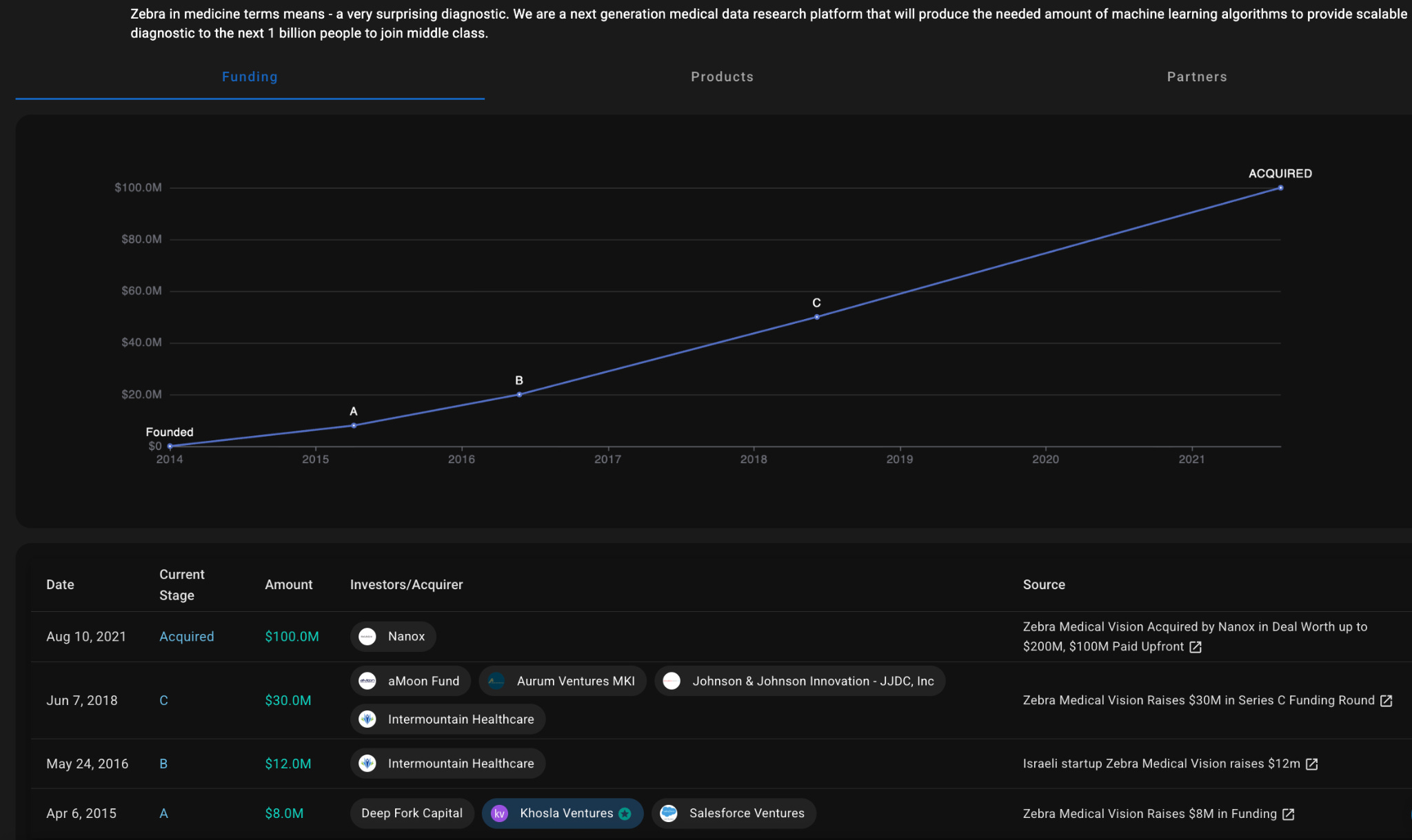
After 3 years of funding Zebra himself, Gura raised a seed round of $8M from Khosla Ventures, Marc Benioff and Deep Fork Capital. They hired an engineering team and partnered with the Israeli HMO Clalit to get images for training their deep learning algorithms. In 2016, Zebra Medical Vision signed a deal with Intermountain Healthcare which gave them more data.
Courtesy of Byte17
By 2022 - Zebra was not sustaining growth and scaled back its work force.
In April 2022, in a stock-for-stock deal for $100M, Nanox acquired Zebra for its AI technology. Nanox makes digital X-ray technology which had not (and still has not) mainstreamed in a market dominated by GE and Siemens. Nanox wanted Zebra’s AI technology to boost the value of its X-ray product.
Zebra’s team got wiped out on the beach of their acquirer—their technology absorbed into a struggling company with its own existential problems.
Post-IPO Nanox stock traded at 94.8 and is now trading at 2.7 which makes the deal worth $13M in today’s terms. Nanox last reported a net loss of $10.2M in Q4/2025 and continues to struggle with high cash burn and negative gross profit margin.
In late 2017, I got a phone call.
Zebra Medical had their submission for coronary calcium 510(K) rejected because of a series of major deficiencies, including this one: “Your submission does not provide information on how you will protect your device from malware during the production and distribution of your software as recommended in Section 6 of the guidance titled “Content of Premarket Submissions for Management of Cybersecurity in Medical Devices”.
Coronary artery calcium (CAC) was a great place to start. CAC is a marker of plaque buildup in the heart’s arteries, and 30-50% of the general adult population, a number that rises to 60-90% in people over 70 in the US.
Could I come in and help? Yes I could and yes I did. Within 4 weeks, working closely with the engineering team, I collected data, built the threat model and wrote up the documentation for the FDA Cyber part of the submission.
They cleared the FDA for CAC. Good customer - paid me and never called.
They later went on to receive clearance for 7 indications.
But they were not getting traction, despite ‘leading the way in AI FDA cleared products’.
Zebra got stuck in the reimbursement chasm.
What they built (technical excellence):
7 FDA clearances
Superior deep learning platform and engineering
First-ever AI CPT code (Category III) for VCF detection - huge industry milestone
Real clinical deployments globally
Partnerships with Intermountain, Cedars-Sinai, Oxford
Where they got stuck (GTM failure):
Selling low: Initially set a fixed price of $1/scan for use of their system for diagnostic triage.
Pricing model wrong: $1 per scan analyzed sounds elegant, but creates chicken-egg problem:
Hospitals won’t deploy without proven ROI
Can’t prove ROI without volume
$1/scan for a $250 test is too low and unsustainable.
Volume requires infrastructure already deployed
Category III CPT code paradox: They achieved the first AI radiology CPT code in July 2021, but payment decisions are made locally at payor discretion, with highly variable reimbursement rates and significant time lag. So they had the code but no guaranteed payment.
Population health positioning: They pivoted from diagnostic triage to population health screening, but this requires:
Payer contracts (not provider contracts)
Long sales cycles with health plans
Value-based care adoption (still nascent in 2021)
Revenue model confusion: Sources mention both subscription and per-scan pricing. This suggests they were thrashing between business models - never a good sign.
Breaking the law of line extension: There is an irresistible pressure with founders to extend their brand equity. As Ries and Trout write in their book, “The 22 immutable laws of marketing” - If violating this law was a punishable offense, a large portion of corporate America would be in jail. One day you’re laser-focused on coronary calcium and boom - the next day you’re doing 6 more indications.
Management had to decide what to do next. The question was never answered successfully.
Design patterns instead of founder goals
Instead of driving your TechBio company to achieve goals - design for time, design for change and above all - design for buyers.
Design for buyers. Eyal Gura’s original goal was personal - bring X-ray diagnosis to the masses anywhere, anytime. He was not alone in starting a TechBio company because of a personal experience. But, personal experience as a patient and ability as an entrepreneur to raise money and build a team don’t mean anything to your economic buyers. They see hundreds of vendors like you every day, and your motivation, while inspiring, is not sufficient motivation for them to buy your product.
Design for change. Sacrifice your dreams and ideas.
The life science and healthcare industries have large, complex and opaque decision making processes. As a founder/CEO, your ability to go to market drops exponentially with each new indication and product you develop and launch. You have to develop, validate, maintain, support, package and price, market and sell and find PMF for each product.
If juggling balls is linear, launching multiple medical indications is exponential. 3 products is 6X more complex than 1 product. 7 products are 5000X more complex than 1 product.
Do 1 thing and dominate the market with that 1 thing. If you have to pivot, you only have to pivot from that 1 thing.
Design for time. We design office space, cars, phones and software systems. We almost never design the time for our company. Certain parameters are constant - like your engineering and operational systems. Others, marketing and sales channels, require time to learn and adapt.
Design challenge for founders
You don’t need 5 years to change your life. Or the life of your company.
Shorten the timeframe. Make it happen in the next 12 months.
It doesn’t take discipline or a Navy seal’s morning routine. It just takes you to be unreasonable enough to want a better life.
It requires you to make big, uncomfortable decisions and stop trying to be a fortune teller who can predict the future.
I dare you to do the unthinkable. Change your design.
This week on Life Sciences Today
Dr. Gary Zammit, founder and CEO of Clinilabs, joined Life Sciences Today to unpack 25+ years building a CNS‑focused CRO through boom, near‑bust, and a 2024 PE exit. His core thesis: success in drug and device development is “beyond science” — it’s the trinity of people, processes, and systems. The real failure in clinical R&D isn’t regulations or protocols; it’s neglecting the human factor and the formation of truly effective teams. Clinilabs’ moat is radical focus: they are the only full-service global CRO dedicated exclusively to CNS, compounding thousands of hours of domain practice into culture and execution.
One powerful anti‑pattern Gary called out: copy‑pasting protocol designs from prior studies. Teams believe they’re inheriting “best practice,” but often inherit embedded mistakes. The better pattern is to start from the end-state — the label and the paper you want to publish — and work backwards to the optimal trial design.
You can see the show here

In 2026, I’m working with 100 founders
I’m giving 100 founders access to my pattern library and a free strategic audit.
I’ll review your 2026 plans and tell you what breaks first. After our 60’ phone call, I’ll send you a written assessment and circle back with 30 and 90 day follow-up calls.
Get it here:
About me
I’m an entrepreneur, writer, host of Life Sciences Today podcast, ex-pharmatech founder, father of 4.
I’ve been building in tech, cyber, privacy, and clinical data for 25+ years across Israeli medical device startups, Verily, Amgen, and the Fortune 1 company.
I work at the intersection of business, engineering, AI and clinical data.
If you love my writing — share it
A powerful reminder that outcomes follow design, not ambition. The Zebra story is a clear lesson in why GTM, pricing, and buyer reality matter as much as technical excellence