

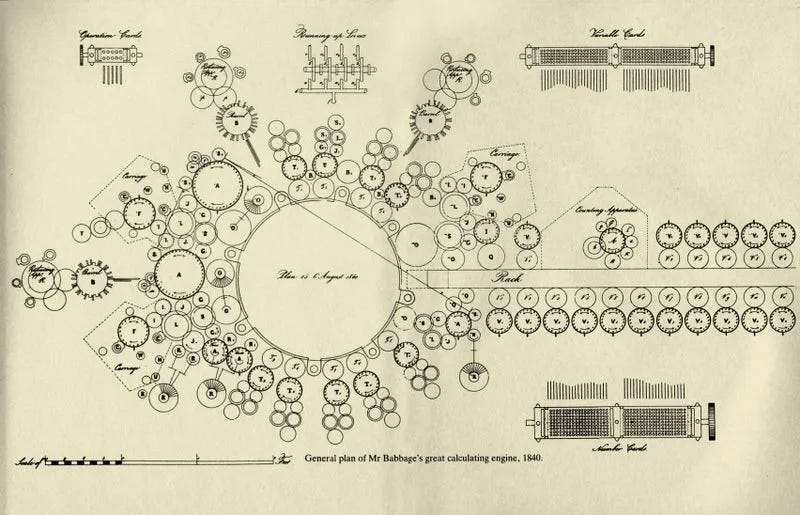
An old drawing of Babbage’s great calculating engine. Complexity => risk.
Introduction
Great software needs great teams, most teams are like dysfunctional families - they have a threat surface you cannot control.
A new NeurIPS 2026 paper showed a proof of a federation learning threat surface: the model updates exchanged during federated training can contain enough information to reconstruct individual chest X-rays, CT images and pathology tiles.
Quote courtesy of Jim McCarthy, Dynamics of Software Development
Model inversion attacks
In federated learning, each hospital trains the model locally and sends gradients or updated parameters to a coordinating server. The server combines those updates into a shared model.
The attractive message is simple: “We do not collect your data.”
Technically, that can be true. Commercially, it removes one of the largest obstacles to multi-institutional medical AI.
The problem is that gradients are not harmless metadata. They encode information about the examples that produced them.
Model-inversion attacks exploit that information to reconstruct training samples. Earlier attacks worked mainly against small batches or unrealistic configurations. Newer attacks—including Robbing-the-Fed, LOKI and Scale-MIA—use specially constructed model layers to recover inputs in closed form at clinically realistic batch sizes.
Some can work even when secure aggregation is used.
That changes the threat model. The coordinating server is no longer merely infrastructure that might be breached. It can itself become the adversary by distributing a model engineered to extract client data. A hospital may be unable to distinguish the malicious model from the legitimate one before training begins. arxiv.org
The feature that creates the commercial advantage—learning across institutional boundaries—also creates a pathway through those boundaries.
A countermeasure that uses synthetic collisions
The new paper, Aegis: Generative Gradient Masking for Privacy-Preserving Medical Federated Learning, proposes an interesting countermeasure.
Current model-inversion attacks have a structural limitation. A specially constructed model layer has a finite number of “leakage bins.” When too many images contribute to the same bins, their signals collide and the reconstruction becomes a blended, unusable image.
Aegis deliberately creates that collision.
Each hospital generates task-relevant synthetic images locally. It computes an additional masking gradient from those images and combines it with the real training update. The effective batch becomes larger than the attacker’s leakage capacity, causing reconstructed patient images to collapse into mixtures.
The synthetic images and masking process remain at the hospital. The federated-learning protocol does not need to change.
In tests covering chest X-rays, abdominal CT images and colon pathology tiles, the authors report reconstruction rates of 78%–89% without a defense. Aegis reduced them to roughly 9%–12%, while test accuracy remained close to the undefended models.
For ChestMNIST, for example, the reported reconstruction rate fell from 89.06% to 9.50%, while accuracy changed from 55.8% to 55.5%. Similar results were obtained using four different image generators. arxiv.org
That is promising because conventional countermeasures create an uncomfortable tradeoff. Differential privacy adds noise that may reduce clinical performance. Gradient pruning removes information the model could have learned from. Cryptographic aggregation increases complexity yet does not necessarily stop an actively malicious server.
Aegis attempts to preserve both assets: patient confidentiality and diagnostic utility.
We need a new countermeasure design
The results should not be converted directly into a product claim.
The medical tests used benchmark-resolution MedMNIST images—not full-resolution CT volumes, whole-slide pathology or prospective hospital deployments. The protection targets the current family of scalable linear-leakage attacks. A future attack may avoid the same bottleneck.
The server can also increase the capacity of the malicious layer. Aegis must then generate a larger masking batch, increasing compute and latency. The synthetic data must be close enough to the real clinical distribution to create useful collisions without distorting learning.
The theoretical convergence result uses standard convex assumptions that do not hold for the deep neural networks used in practice. The authors appropriately rely on empirical results for those models. arxiv.org
This is therefore evidence for a new countermeasure design—not evidence that federated medical AI is now safe.
What MedTech founders should do
Do not describe federated learning as privacy-preserving merely because raw records remain local.
Make the narrower, defensible claim: patient records are not centrally transferred. Then determine whether the updates can recreate them.
Before deployment, the privacy test should include:
Model-inversion attacks against the actual architecture, batch sizes and aggregation protocol.
An adversarial-server scenario, not only interception of an honest server.
Inspection or attestation of models sent to participating hospitals.
Measurement of reconstruction success—not just encryption status.
Comparison of privacy controls against their effect on clinical performance.
Controls for poisoning, backdoors and malicious clients, which Aegis does not address.
Repeat testing after changes to the model, generator, batch configuration or federation protocol.
The loss event should also be modeled correctly.
It is not “an attacker views a gradient.”
It is “identifiable patient images are reconstructed from model updates,” followed by privacy notification, contractual claims from hospital partners, regulatory investigation, suspension of the data collaboration and loss of the very institutional network that created the product’s advantage.
That is a commercial point.
Federated learning may still be worth the bet - a defensible multi-hospital dataset without building a central patient-data warehouse.
But the founder question has changed:
Can you prove that the information leaving each hospital cannot be turned back into the patients who stayed behind?