

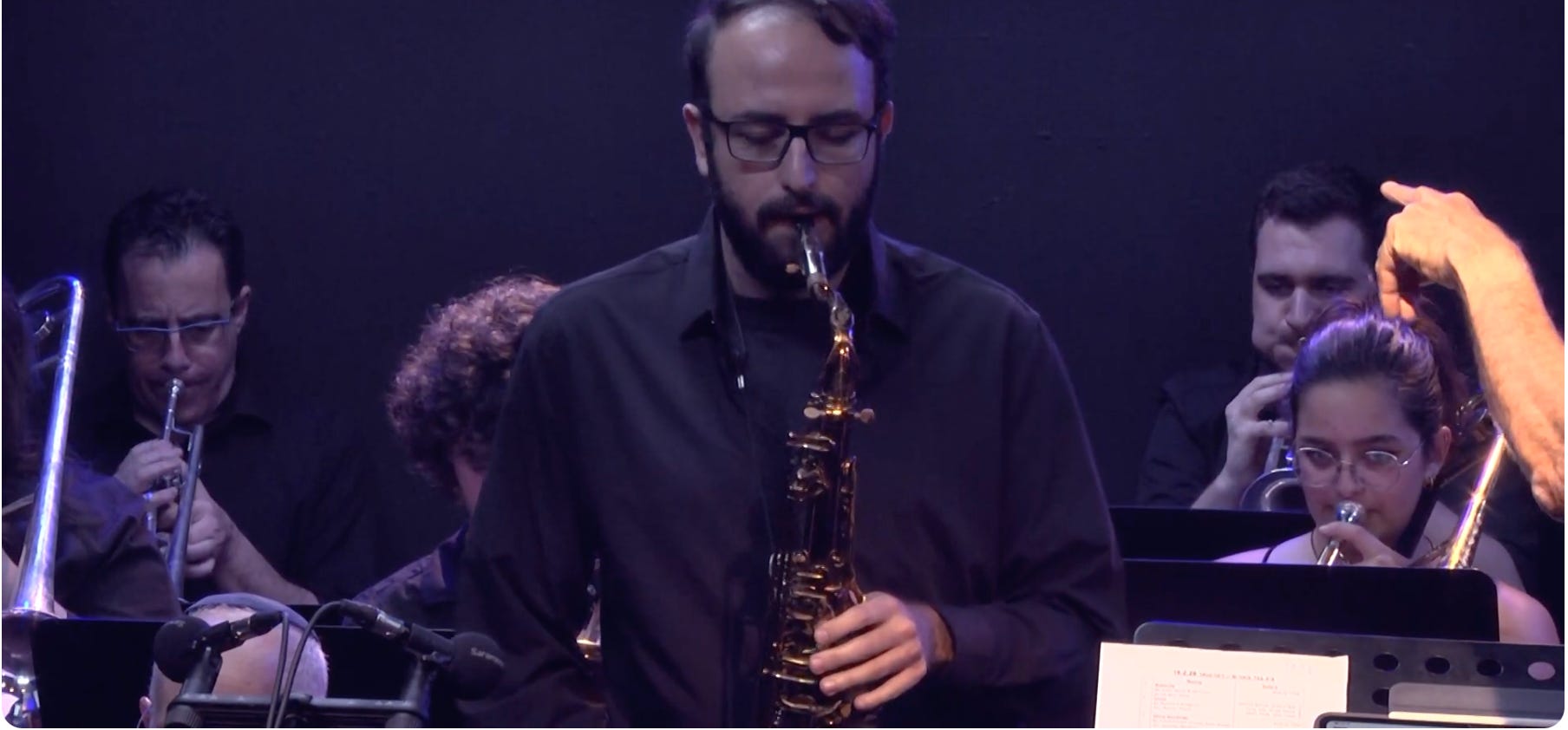
The Thelma Yellin Alumni Band
Your edge is not AI.
Your edge is your ability to listen to other people.
This week, 2 absurdly unrelated things reminded me of that.
I ordered a new alto sax mouthpiece and we finished Cycle 4 of the R&D on OpenCRO - the AI risk officer.
The journey to the edge
I play Alto 2, and double on clarinet in the Thelma Yellin Alumni Band in Tel Aviv. I started my big band journey with my friend Bob Trachtenberg - an awesome musician in his own right who co-founded the Modiin JP Big band with me 23 years ago.
Today I play a Selmer Concept mouthpiece and a Legere 2.5 synthetic reed on my Selmer Series III alto. The setup is quite comfortable for me except that the Selmer Concept is a classical mouthpiece and the guys say that they can’t hear me.
So I jumped on the journey to the holy grail once again. I play a 10MFAN Robusto 8 on my Mark IV tenor and it is great.
Looking for more edge for that Phil Woods sound on my alto.
Not polite classical.
Mark Sepinuck (10MFAN is his handle) is one of the best mouthpiece makers around today.
I talked with Mark and Robert Anchipolsky (a local Israel saxophonist - he’s a monster musician and plays 10MFAN on his alto). After some discussion - Robert convinced me to get a Showboat 6 for my alto.
I didn’t buy the Showboat 6 from Mark because of AI, social media or tech.
It was Mark (and Robert’s) knowledge. Reputation. Relationships. Musicianship. Good judgment - and the product of years spent getting very good at one thing.
Trusting and listening to them was why I bought the Showboat 6.
Design pattern: Performing risk analysis in 60s not in 60 days
There is a great deal of value for a CEO to understand her value at risk at any point in time.
Ask a question and get an answer in 60s without having to deal with data plumbing and consulting services.
Back in the day, I had a cybersecurity and privacy consulting company.
We built risk models with prioritized, cost-effective mitigation plans.
Customers all the way from Walmart Vision to Israeli medical device startups.
A typical project would take us a couple of months - collecting data, building the risk model, validating, writing reports and doing iterations of document review with the customer. There was a lot of annoying copy and paste in Office.
A few months ago, I thought we could revisit the risk analysis problem and remove the copy and paste pain.
When we started developing OpenCRO - we used AI agents and got the time down from 60 days to 14 days. Proved it with a paying customer.
Then 2 days. Then 2 hours. Now 60s.
Now we are working on the set of all 1,501 FDA-cleared AI-enabled medical devices in a broad range of medical indications from radiology to neurology to blood tests.
At the end of this engineering cycle we have coverage, hygiene and completeness:
Coverage: 1500 risk models for 1500 cleared AI devices.
Model hygiene: Removed 2,812 threat rows attached to 271 nonexistent models.
Classification completeness: after manual repair of 17 exceptions, 100% of production threats are mapped into a controlled 24-class taxonomy.
60s changes the economics
We can generate a risk model for a new medical device in 60s - all you need is the FDA submission number.
Who cares?
Well - say you are CEO of a pharma or healthcare organization using medical devices.
Your risk changes in real-time. Hackers. Competitors. Bugs.
The FDA and device vendors operate on a 2-5 year cycle..
You can refresh your risk model in 60 seconds.
7 things founders can learn from jazz
A big band is a masterclass in building something extraordinary, and that’s where startup founders and jazz meet.
Here are 7 things founders can learn from big band jazz.
Let’s hit the first note: Listening.
Listening. If there is one thing you should remember in any team/large ensemble, it should be this rule:
“If you can only hear yourself, you’re playing too loud”.
Listening is a foundational component of teamwork, music and any creative activity.
While the tech industry labels everything as 'engineering,' much of it remains an art. You can say software engineer, but the person is still a programmer. You can say “prompt engineering” but it’s still black magic.
Especially when the AI lies to you.
A good professional programmer (like a professional musician) has 3 essential qualities: Good designer, good communicator, good coder. Good designer of software (or music), good communicator (with the team or the ensemble), good coder (master of your craft or instrument).
Great software is the product of design, communications and workmanship. Notice I didn’t mention AI in this definition.Technique. I will specifically use examples from woodwinds (for some bizarre reason a sax is a woodwind). Technique is a polyglot of things. It means fingering, breathing, breathing and fingering, music reading, it involves memory of how to finger a particular phrase, extremely rapid retrieval of patterns from the associational cortex (at 400 BPM - this means retrieving entire phrases of 8-16 notes in 150ms).
Good technique is often measured in speed. Inside the ensemble, an individual player’s technique is often challenged by the tempo that the ensemble is playing (or attempting to play).
In a team - good technique means being able to do your job at the same tempo as the rest of the team and at the tempo dictated by the leader. In a big band - if the individual musicians’ technique is not up to the piece, then the group needs to try something easier. In a team - trying something easier is an alternative pathway until the “engineers” can achieve the professional proficiency and speed required to deliver a high quality product to market, support customers at Coltrane’s Giant Steps tempo, and sell the product at a cadence that leaves positive cash flow for the company.Time. A musician who has good “time” stays on the beat with himself and the rest of the ensemble, even when the music has complex rhythms. The ability to recognize rhythm and keep time is established in the developmental brain up to the age of 14 months. This is apparently unrelated to ethnic origin and language. If you want your child to be able to play Brazilian rhythms, they need to hear that kind of rhythm as a baby.
The analog in a tech team is staying in the same cadence as your teammates. It’s pretty simple. If a teammate needs a piece of your backend software tomorrow, then you need to deliver it to her exactly when she needs it.Harmony. Harmony is an entire topic unto itself and relates to how the brain interprets intervals of notes. The rules of harmony were set by Bach 400 years ago and continue today in jazz, pop and classical music. Atonal music (like Alban Berg and some free jazz), breaks the rules which is why it’s difficult to hear for many people. Big bands play from written charts with open space for improvisation. The charts have a harmonic rhythm of chord progressions. The progressions themselves have rules. Rules however are meant to be broken.
According to a study from Yale, music needs to surprise the listener 50% of the time more or less.
Less is boring. More is too surprising for the listener.
A software product is a reflection of the software team.
A software team is the leader’s product.
Harmonious teams and leaders make harmonious products.
Surprising the user with a cool feature every so often can be very satisfying. Like surprising listeners (but not too often).Awareness. Awareness has many levels and is a topic for neuroscience. In jazz ensembles, awareness of time, melody, harmony and dynamics lives at the individual musician and ensemble level.
When the musicians and ensemble are individually and collectively aware - you can achieve greatness.
Software is no different.Practice. Practice at home. Learn the charts and changes. Come prepared for the rehearsal. Come prepared to make music, not figure out the fingering.
The topic of practice for technology teams is highly neglected.
I can best illustrate this with a quote from my boss and mentor at Rad-Bynet - Yehuda Zisapel of blessed memory.
“If you’re a salesperson - practice your sales technique for an hour/day. If Michael Jordan could practice layups 2 hours / day for his entire career, so can you if you want to exceed your quota”.Improvisation. Jazz improvisation can be learned. I’m not sure it can be taught.
Improvisation is in a way, the culmination of everything: your ear, technique, tone, phrasing, rhythm and time, melody and harmony, awareness and listening.
Improvisation is highly based on your muscle memory; pieces you transcribed, great artists you listened to, your own ideas and lines from the masters you made your own.
In software teams, improvisation is often required in a time of crisis. When the system crashes or when you need to make a special deadline for a quote or delivery, the team improvises to get the job done.
As in jazz, successful improvisation in software is something you learn over time.So you studied clarinet in 6th grade and then sax in high school. You practiced and became better and now you play in a big band. You learned the charts at home, listened to other performances and mastered the phrasing. The ensemble rehearsed and is ready for a live performance.
Just like in software. Well - almost like in software.
Go out there and enjoy yourself.
The Thelma Yellin Alumni band live - that’s me between Ariella and Noam.
Your edge is not AI
Mark, Robert, musicians and engineers teach us that your edge is not AI.
Anyone can use the same models, anyone can build agents, anyone can copy your workflow.
Your edge is what the AI doesn’t have.
Your data, your domain knowledge, your personal network, reputation, your accumulated good judgment.
Your personal workmanship.
AI makes building cheap.
It makes all of those things more valuable.
And if you can use AI + your accumulated advantage to increase your customers’ alpha?
That’s an incredible edge to have.
PS — Or help make you sound like Phil Woods.